



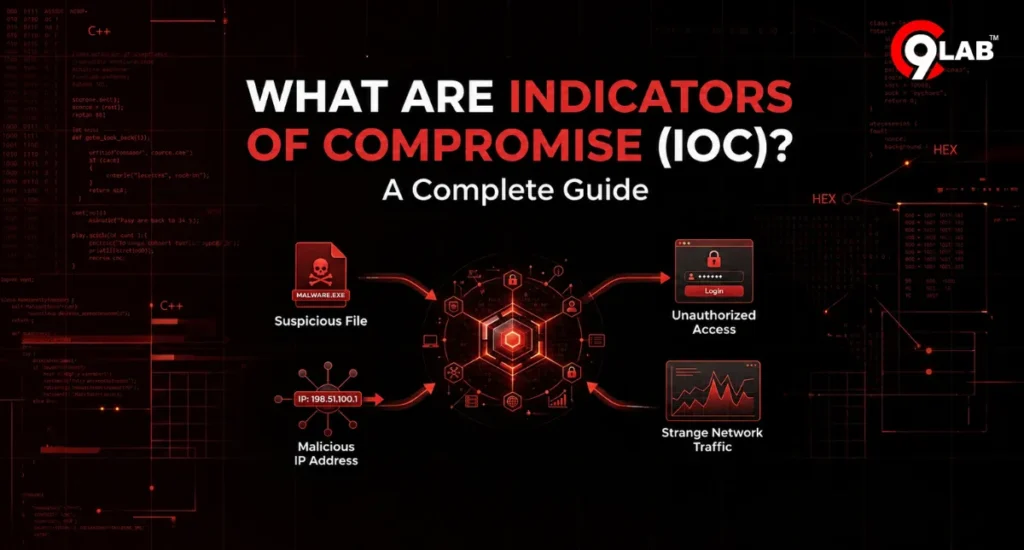
What are Indicators of Compromise (IOC)?
Indicators of Compromise, or IOCs, are basically warning signs that something isn’t right inside a system, network, or application.
You usually don’t “see” the attack happening in real time. What you notice instead are small, unusual activities that don’t quite add up. For example, a system suddenly connecting to an unknown IP, multiple failed login attempts followed by one successful login, or a spike in data being sent outside the network.
Sometimes it’s even simpler things like a password getting changed without context, a new user account appearing out of nowhere, or files showing up that no one remembers creating.
On their own, these might not look serious. But when you step back and connect the dots, they start telling a story.
That’s exactly what IOCs do. They act as pieces of evidence. When analysed properly, they help confirm whether a system has actually been compromised.
In most organizations, security teams rely on these signals to detect threats, investigate incidents, and stop things from getting worse.
How Indicators of Compromise Work
Every cyberattack leaves a trail behind. It might not be obvious, but it’s always there.
IOCs are about finding that trail and making sense of it.
It usually starts with continuous monitoring. Systems are always watching, tracking login attempts, file changes, network traffic, and general behaviour. The goal is simple: spot anything that feels off.
Once something unusual is detected, data starts getting pulled in. Logs from servers, endpoints, firewalls, and cloud systems are collected so there’s enough context to understand what’s going on.
Then comes the real work—analysis. This data is compared with known threat patterns and existing IOC databases. If something matches, or even looks similar, it raises a flag.
But not every alert means there’s an attack. So, the final step is validation. Security teams step in, verify what’s happening, and decide what to do next. That could mean isolating a system, blocking an IP, resetting credentials, or triggering a full incident response.
Most of this process today is supported by tools like SIEM and EDR platforms. They don’t replace human judgment, but they definitely speed things up.
Types of Indicators of Compromise
IOCs can show up in different ways depending on where you look. Understanding these categories just makes detection sharper.
- Network-based indicators: This is where you look at how systems are communicating. If a machine starts talking to a suspicious IP, sending unusual amounts of data out, or making strange DNS requests, that’s usually an early warning sign. It often means something external is interacting with your system.
- Host-based indicators: These are visible directly on devices, laptops, servers, endpoints. Things like unknown processes running in the background, system settings being changed, or security tools getting disabled. This is where you start seeing how deep the problem goes.
- File-based indicators: Sometimes the issue is right there in the files. Suspicious file names, unexpected downloads, or changes in file integrity (like hash mismatches) can signal malware or unauthorized activity.
- Behavioural indicators: This is less about technical signatures and more about patterns. For example, a user logging in from two different locations within minutes, repeated login failures followed by success, or unusual data transfers at odd hours. These are often the hardest to catch—but also the most valuable.
- Metadata-based indicators: This goes a level deeper. Files and documents carry hidden details—like who created them, when they were modified, and how they’ve changed over time. If something looks inconsistent here, it can point to tampering. This is mostly used during deeper investigations or digital forensics.
Examples of IOCs
In real scenarios, IOCs don’t show up as big red alerts. They show up as small, slightly odd events. Like:
- A system regularly connecting to an unknown external server
- A user logging in from two different countries within a short time
- Sensitive data being accessed at unusual hours
- An antivirus flagging a file no one officially installed
- Multiple failed login attempts followed by a successful one
Individually, these don’t always mean a breach. But when you start seeing a pattern, that’s when it becomes serious.
How IOCs Are Used in Security Operations
In most security teams, especially in SOC environments, IOCs are part of the daily workflow.
- It usually starts with threat intelligence. Organizations pull in updated lists of known malicious IPs, domains, and file signatures.
- Then comes continuous monitoring. Systems constantly check whether any activity matches these known indicators.
- If something matches, an alert gets triggered. But alerts alone don’t mean much unless someone investigates them. Security analysts step in, validate whether it’s a real threat, and filter out false positives.
- If it turns out to be genuine, action is taken immediately contain the threat, stop the spread, and figure out what exactly happened.
Difference between IOCs & IOAs
- IOCs (Indicators of Compromise) are about evidence. They tell you that something has already happened. For example, a system connecting to a known malicious IP or unauthorized file changes—these are signs left behind after an attack.
- IOAs (Indicators of Attacks), on the other hand, are about behaviour. They focus on identifying suspicious intent before things fully unfold. Like repeated attempts to escalate access, unusual user actions, or abnormal system patterns.
So, while IOCs help you confirm and investigate, IOAs help you catch things earlier. In reality, both work best together.
Limitations of IOCs
- IOCs are useful, but they’re not perfect.
- One major issue is that they’re mostly reactive. By the time you detect them, some damage might already be done.
- Attackers also adapt quickly. They can change IPs, modify files, or tweak their methods to avoid detection.
- Static indicators like file hashes become outdated fast. And if you rely only on IOCs, you might completely miss more advanced attacks that don’t follow known patterns.
Conclusion
IOCs are still a core part of cybersecurity. They give clear signals when something is off and help teams understand what went wrong.
But the real strength comes from how they’re used.
When combined with behavioural analysis, proactive monitoring, and a solid incident response setup, they become much more powerful.
Because at the end of the day, it’s not just about detecting a breach—it’s about catching it early enough to actually control the damage.




Comments
Join the discussion. We’d love to hear your thoughts.