


Cybersecurity has quietly evolved from a concern within operations to a national level. Something that once existed within information technology and security groups is now influencing conversations at the executive table and within government and regulatory settings.
In a global context, national cyber-strategies are in a state of rapid evolution, and thus, so are the demands being placed upon organizations.
This is not primarily a matter of more robust cybersecurity. It is a recognition that the very foundations of economic, public service, and trust-based systems rest on digital technology.
Consequently, federal cybersecurity policies are no longer limited to securing government computers. Rather, it is shaping the way businesses operate and interact.
A clear shift in how government approach cybersecurity
For a long time, government cyber-security policy has centered on framework documents, alerts, and voluntary guidelines. And although best practices have been urged, enforcement has traditionally been minimal. All that is now changing.
Modern national cyber strategies focus on accountability, coordination, and results. A clearer role for the involvement of both public and private actors in these strategies is being established.
The goal of these strategies is not to control how companies handle cyber incidents but to address risks before a crisis arises that affects the whole nation.
Cyber security is presently being handled as a community responsibility. “Governments establish the base; the enterprise community must drive and deliver, and during incidents, governments and enterprises must work together.”
Why critical infrastructure is the central focus?
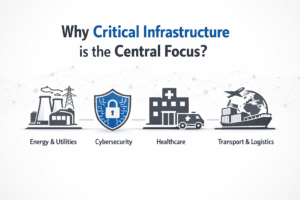
One of the strongest signals in recent policy shifts is the heightened attention on critical infrastructure security. Energy grids, healthcare systems, financial services, telecommunications, logistics, and cloud platforms are no longer viewed as isolated sectors. They are deeply interconnected.
A cyber incident in one area can quickly cascade into others. A disruption in telecom impacts emergency services. A breach in healthcare affects public safety. A failure in financial systems erodes trust at scale. National cyber strategies reflect this reality.
As a result, organizations operating in or around critical infrastructure are seeing higher scrutiny, stricter expectations, and increased pressure to demonstrate resilience, not just protection. This includes redundancy planning, real-time monitoring, and coordinated response mechanisms that go beyond individual organizations.
Policy shifts affect more than regulated industries
A common misconception is that federal cyber strategies only matter to government agencies or heavily regulated sectors. In practice, the impact is much wider.
Updated data protection laws and expanding cybersecurity regulation influence entire ecosystems. Vendors, SaaS providers, cloud platforms, consultants, and third-party service providers are increasingly held to the same standards as their clients. Even startups and mid-sized firms feel the effect through contracts, audits, and customer expectations.
Organizations are now being evaluated not only on how well they protect their own data, but also on the risks they introduce into supply chains. Trust has become transferable. A weak link anywhere in the chain can create exposure everywhere.
From compliance-driven to risk-driven security

Perhaps the most significant change reflected in national cyber plans is the transition from checkbox compliance. Cyber compliance is no longer or has become insufficient when considered solely on its own terms.
It has become clear that readiness is now considered to be of more importance than readiness certification. The implication is that companies must be able to analyze threat profiles and make knowledgeable decisions regarding readiness rather than strictly going by policies and documentation.
All these are particularly applicable to leadership teams. Cybersecurity is now being perceived as a “business risk” as opposed to a “tech issue.” The decision on investment, partnership, data governance, and crisis response policy all involve security considerations that can no longer be fully delegated to boards and executives.
What leaders should focus on now?
In light of developments in national strategies for cyberspace and policy changes, certain priorities have emerged for organizational leaders:
First of all, visibility is important. A leadership group must have a clear understanding of where their most sensitive information resides, how it flows, and who has access to it. Otherwise, their efforts in both areas are just skin-deep.
Second, the readiness for incidents is important. This is because faster reporting needs as well as more stringent reporting requirements mean that readiness for incidents is expected in the organization.
Finally, third-party risk should no longer be treated as an afterthought. Vendors and partners are now an extension of the security posture of an organization. Sound due diligence work on third-party risk is what is now being expected.
Finally, there is a need for cybersecurity considerations at an executive level. National strategies have made it clear that there is strategic, financial, and reputation-based risk associated with cyber. There is blindness associated with cybersecurity at an IT level, blindness from which policymakers have moved to cure.
Conclusion- National cyber strategies and federal policy shifts
National cyber strategies and federal policy shifts are not about control. They are about stability. As digital systems become central to how economies function and societies operate, governments are setting the groundwork for long-term resilience.
For organizations, this moment presents a choice. Some will treat these changes as regulatory burdens and respond reactively. Others will recognize them as signals of where trust, accountability, and value are heading.
Those who align early with evolving federal cybersecurity policy, understand the intent behind cybersecurity regulation, and invest in real preparedness will be better positioned to operate in an environment where security is no longer a differentiator, but a requirement.
Cybersecurity has become part of how credibility is built at scale. Federal policy is simply making that reality harder to ignore.
每天都在战争,希望2026和平.