


Introduction
In the past year alone, India has seen almost a 280% jump in deepfake-related incidents, and it’s becoming clear that this isn’t just a tech issue anymore.
More than three out of four Indians have come across some form of deepfake content, and around 38% say they’ve actually faced scam attempts using manipulated audio or video.
The global picture is even more intense!
In North America, deepfake attacks increased by over 17 times in just one year, and experts believe the United States could lose around $40B to these scams by 2027. That’s almost triple the losses from 2023.
With Indian regulators putting out high-severity alerts through 2024 and 2025, it’s obvious that deepfakes have moved from being a future worry to a real-time threat. And if organisations don’t strengthen how they verify people and information, the impact is only going to get bigger.
What Are Deepfake Scams and Why They’re Becoming a Major Cyber Threat
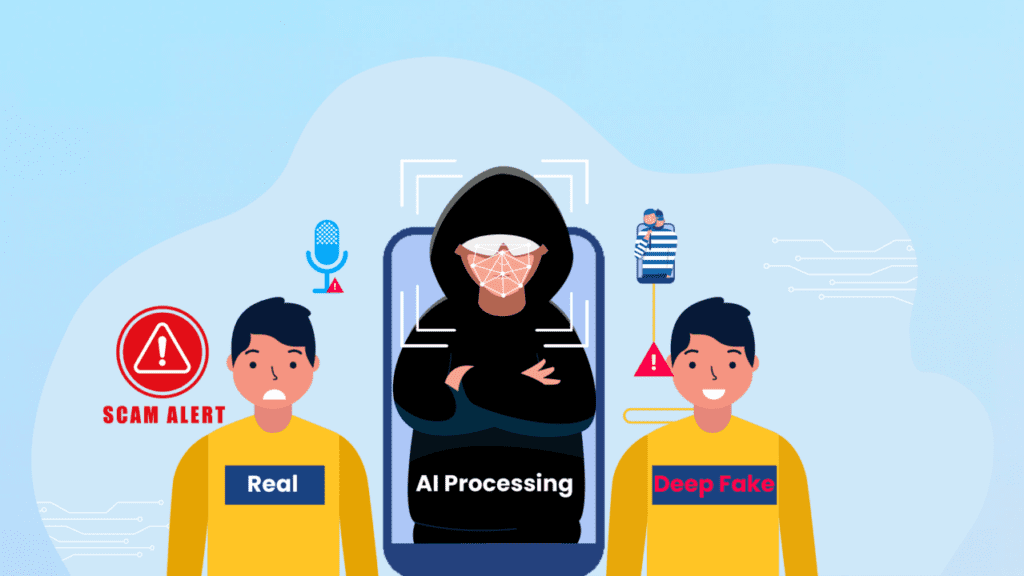
Deepfake scams are a modern form of fraud where cybercriminals use AI to create highly realistic copies of a person’s face or voice. These fake videos or audio clips look genuine, sound accurate, and are extremely convincing even to trained professionals.
How Deepfake Scams Typically Work
- Cyber criminals collect a few minutes of someone’s voice or video from social media, webinars, or publicly shared content.
- AI tools are then used to recreate the person’s face, voice, tone, and expressions.
- A fake message or call is created, usually framed as urgent or confidential.
- Victims are pushed to transfer money, share sensitive information, or approve actions quickly.
Why Deepfakes Are So Dangerous for Individuals and Organisations
Current Scenario: In 2025 a single woman in Bengaluru lost ₹3.75 crore after responding to a deepfake video of a well-known spiritual leader promoting a “too-good-to-be-true” investment scheme (India Today).
In another case the same year, a 79‑year‑old woman was duped out of nearly ₹35 lakh when cyber criminals used AI-generated endorsements of a false trading platform (Times of India).
These are not isolated incidents, they prove deepfakes are already actively used by cybercriminals to target unsuspecting individuals and siphon off large sums of money.
Here are some reasons why deepfakes are a major risk:
- Highly Realistic Imitation: Deepfakes can replicate a person’s facial expressions, voice, and speech patterns with high accuracy, making it difficult to distinguish real content from fake.
- Exploits Trust: Since the message appears to come from a familiar person, recipients are more likely to act without verifying, increasing the risk of fraud.
- Difficult to Detect: Even well-trained employees and executives can be misled by deepfakes, which makes them a significant threat for organisations handling sensitive information or financial transactions.
- Minimal Data Required: Attackers need only a few minutes of publicly available audio or video to create convincing deepfakes, making the barrier to entry low.
- Traditional Security Measures Are Ineffective: Conventional indicators such as suspicious links, poor grammar, or unknown senders do not apply, meaning deepfakes bypass most existing safeguards.
Impact of Deepfake Scams on Businesses
Deepfake-driven cyber fraud is increasingly affecting organisations and can lead to serious financial, operational, and reputational damage:
- Unauthorized Fund Transfers: Employees are tricked into sending money to cyber criminals posing as executives or vendors, sometimes resulting in losses of lakhs or even crores.
- Fake Vendor Payments: Scammers impersonate trusted suppliers, causing businesses to pay fictitious invoices and disrupting cash flow.
- Manipulated Executive Instructions: Deepfakes allow cybercriminals to issue fake orders that appear to come directly from leadership, creating confusion and operational risk.
- Data Leaks and Legal Exposure: Sensitive corporate information can be exposed, leading to regulatory penalties, lawsuits, and reputational damage.
- Even Well-Trained Employees Are Vulnerable: The realistic nature of deepfakes makes it difficult to identify fraudulent requests, showing that no organisation is completely immune.
Impact: Beyond immediate financial loss, deepfake fraud can shake trust within organisations, slow decision-making, and undermine confidence in leadership, making it a strategic risk as much as a technological one.
The Role of Deepfake Detection
Deepfake detection is a critical part of combating AI-driven fraud. While technology helps, it must be combined with human oversight. Key points include:
- Facial Movement Analysis: Detection tools examine facial expressions, micro-movements, and lip-syncing to spot inconsistencies that indicate manipulation.
- Voice Pattern Checking: AI analyses pitch, tone, and cadence of speech to detect synthetic or cloned voices that differ subtly from the real person.
- Digital Noise and Metadata Inspection: Deepfake content often contains digital artifacts or metadata irregularities that are invisible to the naked eye but detectable with specialised software.
- Limitations of Technology: No tool is 100% accurate. Deepfakes are becoming more sophisticated, so relying solely on automated detection can leave organisations vulnerable.
- Importance of Human Verification: Even with detection tools, employees should verify unusual or high-risk requests through secondary channels, such as phone calls or internal approval processes.
- Structured Approval Workflows: Implementing multi-step verification for financial transactions and sensitive actions adds an extra layer of defence, reducing the risk of fraud.
- Ongoing Monitoring and Updates: Detection tools should be regularly updated to keep pace with evolving AI capabilities, and employees should be trained on the latest deepfake techniques.
Smart Cyber Fraud Prevention Practices
Strong cyber fraud prevention today requires a combination of technology and human vigilance. Key practices include:
- Verify Requests Through Secondary Channels: Always confirm financial or sensitive requests via a separate method, such as a phone call, video verification, or email from a trusted source.
- Avoid Acting on Pressure or Urgency: Cybercriminals often create a false sense of urgency. Employees should pause and verify before taking any action.
- Limit Public Sharing of Voice and Video: Reduce the availability of personal or organisational audio/video content on public platforms, as these can be exploited to create deepfakes.
- Train Employees on AI-Based Scams: Regular training and simulations help staff recognize deepfake tactics, suspicious behaviour, and unusual requests.
- Implement Multi-Step Approval for Transactions: High-value or sensitive financial transactions should require layered approvals to prevent single-point failure.
- Promote Awareness as a Key Defence Layer: A culture of vigilance and informed decision-making is the strongest protection against deepfake fraud.
Conclusion
Deepfakes represent a new and evolving threat that targets human trust rather than technology alone. They are no longer a distant risk. Incidents in India and worldwide show that individuals and businesses can suffer significant financial and reputational losses if they are unprepared.
The rise of AI-driven scams highlights the need for a layered defence strategy that combines technology, human vigilance, and organisational processes. Detection tools, multi-step verification, employee training, and awareness campaigns are all critical.
Ultimately, protecting against deepfake fraud is about defending trust. By pausing, verifying, and questioning unusual requests, organisations and individuals can reduce risk, safeguard sensitive information, and prevent potentially devastating losses. In the age of AI, smart decisions and cautious behaviour are just as important as advanced technology.
Comments
Join the discussion. We’d love to hear your thoughts.