


Every business today runs on data. Client records, financial files, emails, project documents, designs, databases. When that data is safe, operations run smoothly. When it is lost, everything slows down or even stops.
Many professionals use the terms Data Recovery and Data Backup as if they mean the same thing. They do not. Understanding the difference is not just technical knowledge. It is a basic business responsibility.
Let’s break it down in a clear and practical way.
What is Data Backup?
It is the process of creating a copy of your data and storing it in another location. This copy can be used later if the original data is lost, damaged, or deleted.
Backups can be stored:
- On external hard drives
- On local servers
- On cloud platforms
- In offsite data centers
The purpose is simple. If something goes wrong, you restore your files from the backup copy.
Businesses use data backup solutions to automate this process. Modern systems can schedule daily or even real-time backups so that minimal information is lost if an issue occurs.
A proper backup strategy usually follows the 3-2-1 rule:
- Keep three copies of data
- Store it on two different types of media
- Keep one copy offsite
This approach reduces the risk of complete data loss.
What is Data Recovery?
It is the process of retrieving lost, deleted, corrupted, or inaccessible data from damaged storage devices.
Unlike backup, recovery happens after something has already gone wrong.
For example:
- A hard drive crashes
- A server fails
- Files get corrupted
- A ransomware attack locks your system
- An employee accidentally deletes critical files
In such cases, businesses rely on data recovery solutions to retrieve information from the affected device.
Sometimes this process is simple. Sometimes it requires advanced tools and cleanroom environments, especially when physical damage is involved. That is when companies approach a professional data recovery company that specializes in retrieving data from failed drives, RAID systems, SSDs, or servers.
Data recovery is often complex, time-sensitive, and expensive compared to maintaining regular backups.
The Core Difference Between Data Recovery and Data Backup
The difference is straightforward.
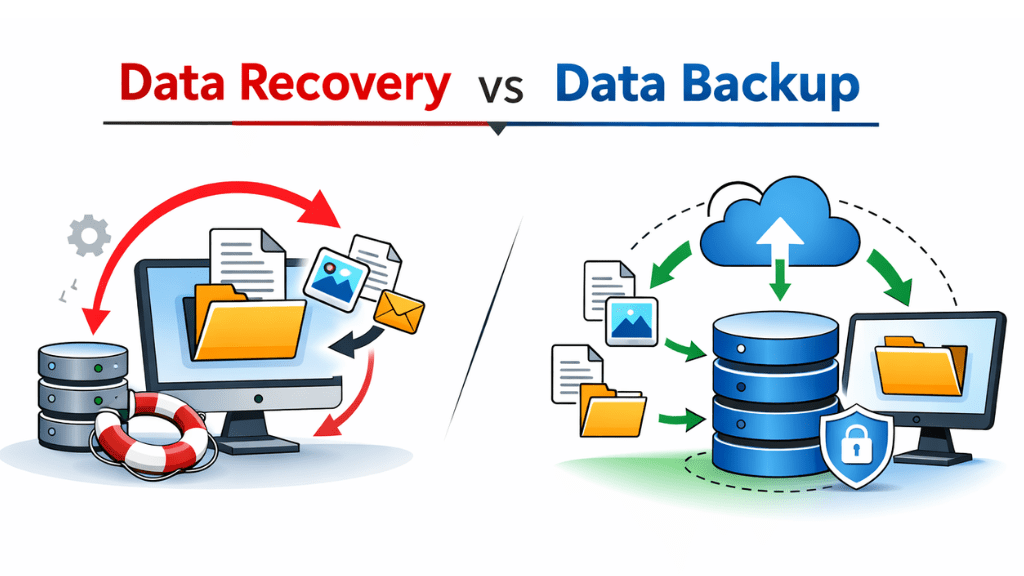
- Data Backup is preventive.
- Data Recovery is corrective.
Backup is about preparation. Recovery is about damage control.
If you have strong data backup solutions in place, you may never need complex recovery services. You simply restore from your latest backup.
But if no backup exists, or if the backup is incomplete or outdated, then you depend entirely on data recovery services to attempt retrieving what was lost.
And here is the hard truth. Recovery does not always guarantee 100 percent success. If storage media is severely damaged, some data may be permanently lost.
Why Businesses Confuse the Two
Many companies believe that if they can recover data when needed, they do not need a structured backup system.
This mindset is risky.
Data recovery is reactive. It steps in after a crisis. It also depends on the condition of the storage device. Logical errors, hardware failure, accidental formatting, or virus attacks can all impact recovery chances.
On the other hand, backup is within your control. You decide the schedule, storage location, encryption standards, and retention period.
Relying only on data loss recovery services without having a backup strategy is like driving without insurance and hoping accidents never happen.
Real Business Risks of Ignoring Backup
Data loss affects more than files. It impacts:
- Revenue
- Client trust
- Regulatory compliance
- Operational continuity
- Brand reputation
For example, industries like healthcare, finance and e-commerce have to deal with customer information every day. Data protection laws in many countries require organizations to safeguard data and ensure recoverability.
If a company cannot restore its systems quickly after an incident, downtime costs can escalate. Studies consistently show that even a few hours of downtime can result in significant financial losses, especially for service-based or online businesses.
Data recovery might restore part of the system, but without recent backups, you may lose days or weeks of work.
When Do You Need a Data Recovery Company?
Even with a strong backup system, recovery services are still important.
You may need a data recovery company when:
- Backup files are corrupted
- Backup was not configured correctly
- Storage devices suffer physical damage
- RAID arrays fail
- Critical data was never included in backup
Professional recovery labs use specialized tools and controlled environments to retrieve data from damaged drives. However, this process can be costly and time-sensitive.
That is why recovery should be seen as a last line of defense, not the primary strategy.
Building a Practical Data Protection Strategy
A smart business does not choose between Data Recovery and Data Backup. It uses both.
Here is a practical approach:
- Implement automated data backup solutions
Ensure backups run daily or in real time depending on business needs. - Use cloud and local storage
A hybrid model reduces risk. - Test backups regularly
A backup is useless if it cannot be restored. Periodic testing ensures reliability. - Encrypt sensitive data
This protects information from unauthorized access. - Maintain a recovery partner
Identify a trusted data recovery company in advance so that you are not searching during a crisis. - Educate employees
Many data loss incidents happen due to human error. Basic training reduces accidental deletion or unsafe practices.
Data Loss Recovery Is Not a Strategy
Many business owners only think about data protection after a system crash. That approach often leads to panic decisions.
Data loss recovery services can help in emergencies. They are highly valuable in situations involving hardware failure or ransomware attacks. But they should support your backup strategy, not replace it.
If you depend solely on recovery, you are accepti ng uncertainty. If you depend on backup, you are planning for continuity.
Conclusion
Data is one of the most valuable assets a business owns. Protecting it requires planning, discipline, and the right tools.
Data Backup protects you before something goes wrong. Data Recovery services helps you when something already has.
The safest approach is simple. Build a strong backup system and keep reliable recovery support as a backup plan.
Businesses that treat data protection seriously do not just prevent losses. They protect their reputation, keep their customers happy and make sure everything runs smoothly even when unexpected things happen.
That is not just an IT decision. It is a leadership decision.
Comments
Join the discussion. We’d love to hear your thoughts.